There is no single correct return target for every family. CPI is a purchasing-power floor, cash is a liquidity tool, and long-run growth in average Australian household wealth can be a reference for relative position. None is a complete answer. We work backwards from the family outcome, then test the result against realistic portfolio returns and tolerable drawdowns. If required return exceeds what the plan can safely earn, we change withdrawals, time, contributions or the end goal—not add unlimited risk.
01 · The thirty-second answer
A required return is not a statement of ambition. It is the output of a family balance-sheet problem.
Set the outcome before the return
Define after-tax capital, annual cash needs and the time horizon first. Without those inputs, a target return is only a wish.
CPI is a floor, not the whole answer
Inflation fits a purchasing-power goal. A family that wants to preserve relative wealth may also study household-wealth growth, without treating history as a guarantee.
A 6% after-tax capital goal needs about 8.8%
In our 20-year model—with 3% inflation, 30% illustrative tax, a 1% withdrawal and 0.5% fees—required pre-tax return is about 8.84%. Change the inputs and the answer changes.
Destroying the plan to chase the number
A higher target is not automatically better. If a tolerable portfolio cannot earn it, extra risk can cause permanent loss, forced selling or illiquidity.
02 · What are we trying to preserve?
Preserve purchasing power
After tax, fees and withdrawals, remaining capital at least keeps pace with long-run living costs. This fits a family that puts stable spending and capital security first.
Preserve choice
If we want to retain access to scarce housing, education, business ownership and intergenerational opportunity, household-wealth growth can be a secondary reference.
Improve relative position
Growing materially faster than the social reference requires more uncertain outcomes, deeper drawdowns or less liquidity. It is a choice, not an obligation.
An objective is the outcome we want. Required return is what a model works backwards to. Expected return is what a portfolio may realistically earn. A hurdle helps decide whether an investment pays enough for its risk. A historical benchmark says only what happened before.
03 · What are CPI, cash and household wealth each for?
| Reference | Question it answers | What it cannot do |
|---|---|---|
| CPI | Is everyday purchasing power being eroded? | It does not track scarce assets, education, housing or other families' wealth. |
| Cash and deposits | Can near-term spending be met without selling in a downturn? | Long-run after-tax return may lag inflation or relative wealth; future deposit rates cannot be locked in for decades. |
| Average household net worth | How quickly did an average household accumulate wealth historically? | It mixes investment return with saving, pension contributions, debt repayment, housing leverage and household structure. |
| Wealth percentiles | If relative position matters, is the relevant threshold rising? | Data are slow and still do not replace a family-specific cash-flow and risk plan. |
Cash is not useless because its return is lower. It provides certainty, liquidity and time for growth assets to recover. Its weakness is long-run compounding. Growth assets offer the opposite trade-off: higher expected return with no guaranteed path. A robust plan normally needs both.
04 · What does Australian history actually tell us?
We use one directly comparable series: average net wealth per Australian household. It is a historical reference, not a portfolio return.
| Period | Starting average household wealth | Ending value | Nominal CAGR | How to use it |
|---|---|---|---|---|
| 2004–2024 | About A$530,500 | About A$1,583,800 | About 5.62% | A long reference spanning several cycles. |
| 2014–2024 | About A$858,400 | About A$1,583,800 | About 6.32% | More recent, but more exposed to housing and asset-price gains. |
The series includes owner-occupied housing, pensions, businesses and financial assets, less liabilities. It also reflects new savings, compulsory pension contributions and mortgage repayment. It shows that household wealth historically grew faster than CPI. It does not prove that a portfolio with no new contributions will earn 5.6% or 6.3% in future.
If relative position is the real objective, a relevant wealth-percentile threshold is conceptually better than an average. Average wealth is also pulled up by wealthier households. We therefore treat 5%–6% as a reference range, not a target to pursue at any cost.
05 · How do we work backwards to required return?
- After-tax capital growth after withdrawals
- Whether withdrawals are fixed, inflation-linked or a percentage of assets
- The actual entity and tax treatment of income and capital gains
- Management, platform, transaction and advice fees
- Time horizon, liquidity needs and tolerable drawdown
After-tax terminal value = pre-tax terminal value − tax rate × (pre-tax terminal value − inflation-indexed cost base). We solve for the capital-growth rate, then add the pre-tax cash requirement for withdrawals and the fee allowance.
Important boundary: adding capital growth, cash yield and fees is a planning bridge, not an exact portfolio IRR. Dividends, interest, asset sales, rebalancing, credits and interim realisations can produce different tax outcomes. A fixed-dollar withdrawal requires year-by-year modelling.
06 · A$1m over 20 years: where the numbers come from
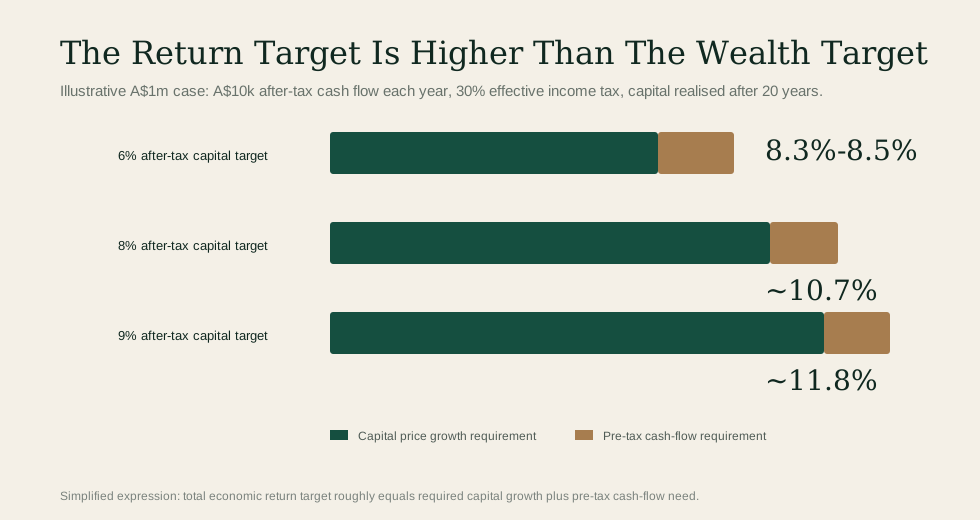
All assumptions are explicit: A$1m starting capital; 20 years; constant 3% inflation; capital realised once at the end; 30% illustrative effective tax on real capital gains; annual withdrawals equal to 1% of opening assets, A$10,000 in year one; and 0.5% fees.
| Planning objective | After-tax capital growth | Required pre-tax capital growth | Pre-tax requirement for 1% withdrawal | Total with 0.5% fees |
|---|---|---|---|---|
| Purchasing-power floor | 3% | About 3.00% | About 1.43% | About 4.93% |
| Relative-wealth reference | 6% | About 6.91% | About 1.43% | About 8.84% |
| Stretch test | 8% | About 9.27% | About 1.43% | About 11.20% |
The middle row says that 6% after-tax capital growth needs about 6.91% pre-tax capital appreciation. A 1% after-tax withdrawal taxed at 30% needs about 1.43% pre-tax cash return. Add 0.5% fees and the planning return is about 8.84%. It is neither a promised return nor a default for every family.
At an illustrative 47% rate, the same 6% capital goal needs about 7.75% pre-tax capital growth; the 1% withdrawal needs about 1.89%; with 0.5% fees, total required return becomes about 10.14%. A statutory minimum rate is not necessarily a family's effective rate.
Australia's 2026 capital-gains reforms have passed and are intended to apply from 1 July 2027, using an inflation-adjusted cost base and a minimum-rate framework for relevant gains. Entity, transition, credit and personal application still need qualified tax advice. The 30% model is illustrative only.
07 · What does a higher return cost?
| Path | Where it can win | What it costs | Common mistake |
|---|---|---|---|
| Cash and short bonds | Low volatility, known liquidity and less forced selling | Lower long-run after-tax compounding and reinvestment-rate risk | Confusing short-run safety with permanent purchasing-power safety |
| Diversified growth portfolio | Higher long-run expected return and less single-asset risk | Material drawdowns and several years below target | Changing strategy after one bad year or chasing recent winners |
| Concentration, leverage or illiquidity | Potentially higher upside | Permanent loss, margin calls, opaque values and lock-ups | Assuming a high required return justifies any risk |
Sequence matters for a family making withdrawals. Two portfolios can earn the same 20-year average, yet the one that falls early may force sales and leave less capital for the recovery. A liquidity reserve and risk budget help the long-run plan survive; they are not merely a return drag.
08 · What makes the plan win or lose?
Objective, portfolio and behaviour fit
Over a suitable period, capital after tax, fees and withdrawals reaches the goal; no liquidity shortage forces sales; and drawdown remains inside the agreed risk boundary.
It looks safe but falls behind
Too much long-term cash leaves after-tax return below inflation or the wealth reference that actually matters. The statement barely falls, while future choice shrinks.
Risk becomes impossible to hold
Concentrated, leveraged or illiquid assets come under pressure together; the family sells at the wrong time; or tax, fees and cash needs were understated.
If required return is higher than realistic expected return
Revisit fixed, inflation-linked or percentage-based spending before adding investment risk.
Give compounding more time and reduce pressure to realise at one fixed date.
Accepting a financial constraint is more dependable than assuming the market will pay more.
Reduce controllable costs and keep a reserve, without treating tax structure as a risk-free return.
A shift from growth to spending or capital preservation; a material change in withdrawal, tax, entity or fees; higher liquidity needs over the next three to five years; or a tolerable portfolio whose long-run expected return is clearly below required return. One weak year does not invalidate a 20-year plan, but changed inputs do.
09 · Sources, formula and notice
This note was updated on 2 September 2026. Wealth data are nominal average net wealth per household. Model results are illustrations, not return forecasts. The existence of tax law and its application to a family are separate questions.
- Australian Bureau of Statistics: household income and wealth for the 2004–2024 average-household series.
- ABS: Australian National Accounts — Finance and Wealth for current household-sector wealth and composition.
- Income Tax Rates Amendment (Tax Reform No. 1) Act 2026 and the capital-gains indexation provisions.
Model boundary: it does not simulate market volatility, sequence risk, FX, distributions, rebalancing, tax credits or fixed-dollar annual withdrawals. Before use, it must be rebuilt around the family's cash flow, entity and tax advice rather than mechanically applying 8.84% or 10.14%.
This note is general research and information only. It is not investment, tax, legal or financial product advice, and it is not a return promise. Qualified advisers should confirm all tax structures.