Microsoft owns one of the world's strongest collections of enterprise-software businesses. Its advantage is not only an AI model: customers already keep documents, email, meetings, employee identities, security rules and procurement contracts inside Microsoft. This creates two possible revenue paths. One is Copilot and higher-priced software; the other is customers building their own AI workloads on Azure. The paths may reinforce each other, but neither makes the other automatic. At the August 2026 historical price, the base path would imply about 12% a year. That is a conditional result, not proof that the downside is adequately compensated. Microsoft is a high-quality company that still has to prove the return on its data-centre build-out.
01 · The thirty-second answer
If you read only one section, read this one. The rest of the note explains these four answers.
It sells software subscriptions and cloud services
Office, Teams, LinkedIn, Dynamics, identity and security products charge companies by user or by year. Azure rents computing, storage, databases and AI by usage. Windows, Xbox and search form a smaller third group.
Enterprise software earns; Cloud grows
Productivity produced about 54% of FY2026 segment operating profit and Intelligent Cloud about 37%. The first has high margins and recurring charges; the second grows faster and needs continual data-centre construction.
AI charges become profit at scale
One path is Copilot seats or consumption. The other is separate customer spending on Azure, data, security and management. They need not be equally large, but at least one must scale and the other must not keep consuming the profit.
A reasonable base path with demanding assumptions
Using $495.40 on 14 August 2026 as the starting point, the simplified three-year annualised outcomes are roughly −8% bear, +12% base and +21% bull. The base path assumes cash property purchases and new lease commitments stop accelerating and Intelligent Cloud segment gross margin stabilises.
02 · What kind of company is Microsoft?
The simplest picture is an enterprise-software cash engine plus a Cloud and AI growth engine. Consumer businesses remain large, but no longer drive the valuation.
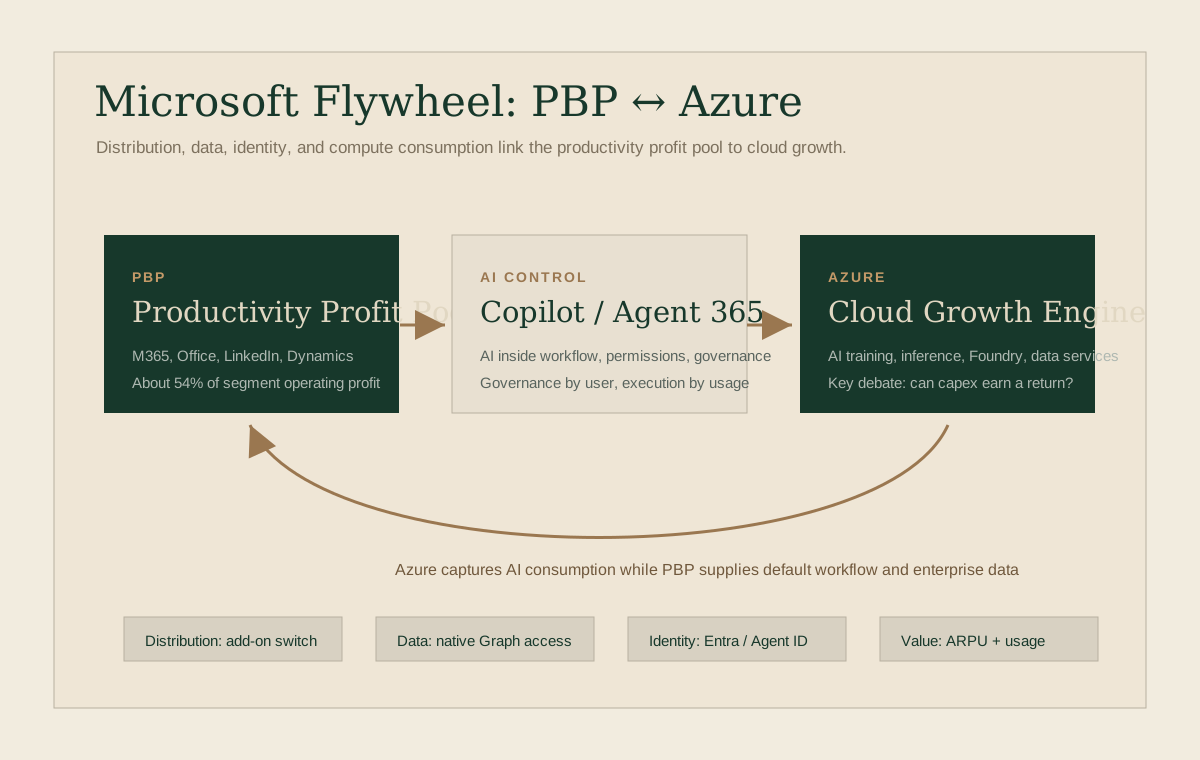
Microsoft 365 includes Word, Excel, Outlook and Teams. Dynamics supports sales and business processes; LinkedIn supports hiring and professional networks. Companies generally subscribe by employee.
Companies must decide who can see data and what AI may do. Entra, Defender and Purview manage identity, permissions, security and compliance—valuable even when a third-party model is used.
Companies rent computing, storage, databases, analytics and AI. Azure runs Microsoft's own Copilots and serves software companies and enterprises across industries. The first is initially a delivery cost; the second is external cloud revenue.
Windows, Xbox, Bing and devices still contribute revenue, cash and consumer distribution, but carry less weight in the case than enterprise software and Cloud.
Reporting segments are not product lists: Productivity and Business Processes is more than Office, and Intelligent Cloud is more than Azure. Security, servers and developer products cross commercial settings, so a segment margin is not a product margin.
03 · Where does the profit really come from?
High-margin subscriptions can fund a vast build-out. The central dispute is whether the quality of new Cloud revenue justifies the rising investment.
| Year ended 30 June 2026 | Revenue | Operating profit | How to read it |
|---|---|---|---|
| Productivity and Business Processes | About $140.0bn, up 16% | About $83.9bn; calculated operating margin 59.9% | Office, Teams, LinkedIn and Dynamics are the main cash engine and contribute about 54% of combined segment operating profit. |
| Intelligent Cloud | About $137.8bn, up 30% | About $57.0bn; calculated operating margin 41.3% | Azure and servers drive growth. A separate measure to watch is calculated segment gross margin, which fell from 62.2% to 58.0%; this is not Azure's standalone margin. |
| More Personal Computing | About $54.1bn, slightly down | About $14.4bn; calculated operating margin 26.6% | Windows, Xbox, search and devices still matter, but no longer dominate the case. |
| Microsoft total | About $331.8bn, up 18% | About $155.2bn; 46.8% margin | The core remains exceptionally profitable, giving the AI investment a long runway. |
Why enterprise customers are hard to dislodge
Replacing Word is easy; moving decades of files, email, accounts, meetings, permissions, security rules, workflows and procurement contracts at once is not. These links create switching friction. A customer may use another company's AI model while still relying on Microsoft for identity, data and compliance. That is a real moat, but not permission to raise every product's price without limit.
Two possible AI revenue paths
The first is software: a company pays for Copilot, a higher subscription tier or additional usage. Azure compute used to deliver that product is initially Microsoft's cost and can pressure software margin. The second is external cloud revenue: customers build their own AI applications on Azure and separately buy computing, data, security and management services. The paths may reinforce each other, but Microsoft does not disclose how much one actually drives the other. At least one must scale profitably, the other must not keep eroding profit, and their combined profit must cover inference and data-centre cost.
04 · What is our investment case?
Microsoft does not need to own the best model forever. Its advantage appears when a customer connects a model to an existing Microsoft environment and can reuse work, identity, data and security systems.
- Work, identity and data remain inside Microsoft
- Copilot moves from sold seats to use and renewal
- At least one AI revenue path scales and the other does not keep eroding profit
- Capacity fills without price cuts and depreciation consuming profit
- Free cash flow per share recovers after construction peaks
How much of the enterprise AI budget stays with Microsoft because Office, accounts, data and procurement are already there—and how much cash remains after the cost of the data centres behind that revenue?
Why revenue growth does not settle the question
Sticky databases, security and management tools are not the same business as a few frontier-model companies leasing large blocks of compute. Both count as Azure revenue. The first carries more switching friction and related charges; the second looks more like capital-intensive leasing, with concentrated customers and clearer pricing. Microsoft does not disclose the mix of incremental Azure revenue, so strong growth proves current demand but not its mix or profit quality.
Capital spending, depreciation and cash
Microsoft generated about $182.9 billion of operating cash in FY2026 and spent about $115.9 billion in cash on property and equipment. The simple difference—free cash flow—was about $67.0 billion, down roughly 6.5%. Profit growth did not fully become cash left over.
Even $67 billion is incomplete. Operating cash flow already includes current operating-lease payments, but this simple measure does not deduct finance-lease principal or recognise a new long-term lease commitment in full when it is signed. As Microsoft increasingly uses leases for data centres, cash purchases alone understate committed investment. Investment happens first; servers and buildings then enter expense through depreciation over several years. Strong operating profit and weaker cash returns can therefore coexist. P/E alone understates the build-out, while peak-construction free cash flow may understate the later harvest. The decisive evidence is whether cash returns after construction slows.
05 · What is proven, and what is not?
Microsoft has proved enterprise demand and core resilience. It has not yet proved the depth of AI adoption or the return on new capital.
| Question | Current view | Evidence and limit |
|---|---|---|
| Is the software cash engine healthy? | Yes, for now | Productivity revenue grew about 16% and operating margin calculated from segment data was 59.9%. Price and product mix matter as well as seat growth. |
| Is there paid and active enterprise AI demand? | Yes, but renewal is unproven | Microsoft 365 Copilot passed 30 million paid seats. Management says conversations per user nearly doubled and average weekly engagement reached the level of Outlook and Teams, but it does not disclose cohort activation, renewal or profit per seat. |
| Is Azure itself still growing? | Yes, quickly | On Microsoft's reported basis, FY2026 Azure revenue passed $100bn for the first time, up 41%, and Q4 revenue grew 43%. Microsoft does not disclose Azure customer concentration, product mix or standalone margin. |
| Do all Microsoft commercial contracts depend on OpenAI? | No, but OpenAI matters | Commercial remaining performance obligations (RPO) were about $678bn, up 84%; excluding OpenAI they grew about 25%, so OpenAI materially lifted the headline growth. RPO includes multi-year Microsoft 365, Dynamics and Azure contracts, with about 30% due to become revenue within a year. Microsoft does not disclose enough to calculate OpenAI's exact share, and this is not Azure-only demand, cash or profit. |
| Is incremental AI Cloud profit high quality? | Not proven | Intelligent Cloud segment gross margin calculated from reported data fell 4.2 points. Ramp cost, product mix and price could all contribute; one decline neither proves commoditisation nor deserves dismissal. |
| Will construction become free cash flow per share? | Not proven | Simple free cash flow fell. It includes current operating-lease payments, but excludes finance-lease principal and does not recognise new long-term lease commitments in full at signing. New capacity must be tested as it enters service and depreciation rises. |
Why OpenAI needs separate attention
OpenAI is an investment, a large customer and a competitor. Its models create Azure demand, while ChatGPT competes with Copilot for the user entry point, and the commercial arrangement can continue to change. This does not imply a contract failure, but one risk can affect investment gains, backlog, data-centre utilisation and product competition at the same time.
Earnings definition: FY2026 GAAP EPS was $17.95. Microsoft's non-GAAP EPS of $17.28 removes the effect of its OpenAI investment, but still includes a roughly $3.2bn pre-tax Anthropic investment gain in Q4. It is a better view of the core than GAAP EPS, but not clean operating earnings.
06 · Valuation and return
The table links business assumptions, earnings and valuation over three years. It is not a set of price targets and does not pretend that scenario probabilities are knowable.
The dated starting point
The test starts at the $495.40 closing price on 14 August 2026. Microsoft's $17.28 non-GAAP EPS still includes the Anthropic gain, while the end estimates exclude unpredictable investment marks, so we do not show a precise-looking starting P/E built from inconsistent earnings. The scenarios assume that in August 2029 the market applies a multiple to our normalised FY2029 EPS estimates. Returns cover exactly three years and exclude dividends.
| Case | What happens to the business and cash | FY2029 normalised EPS × multiple | Assumed price after three years | Annualised from start |
|---|---|---|---|---|
| Bear | Azure growth falls into the teens, Intelligent Cloud segment gross margin remains under pressure, Copilot pricing disappoints and free cash flow per share stays weak. Using $17.28 only as a rough reference, EPS grows about 8% a year. | $21.5 × 18 | About $387 | About −8% |
| Base | Enterprise software holds and Azure and AI keep growing. Cash property purchases and new lease commitments both stop accelerating around FY2028, then free cash flow per share recovers. Rough EPS growth is about 16%. | $27 × 26 | About $702 | About +12% |
| Bull | At least one AI revenue path produces profit at scale and the other does not drag on the whole. Segment gross margin holds and free cash flow per share rises quickly. Rough EPS growth is about 19%. | $29 × 30 | About $870 | About +21% |
How to use the table: Microsoft need not lose Office for the bear case. The 8%, 16% and 19% figures use $17.28 only as a rough earnings-growth bridge; because that starting figure includes the Anthropic gain, they are not strict like-for-like calculations. This is a price-sensitivity test: it includes a cash-flow direction, but cannot prove the return on capital and assigns no probability to the cases.
At this historical starting point, the base path would imply about 12% a year, which looks respectable. Without probabilities, however, the table cannot show that the downside is adequately compensated. Microsoft's existing businesses provide a substantial foundation, and the price already recognises much of that quality.
07 · How does the investment win or lose?
Microsoft can keep its enterprise position and the stock can still lose. The realistic failure is a great software company gradually becoming a heavier, slower-growing platform.
AI charges become profit and cash at scale
Microsoft 365 seats and price hold; at least one AI revenue path produces profit at scale and the other does not keep eroding the whole; Intelligent Cloud segment gross margin stops falling; free cash flow per share recovers as cash purchases and new lease commitments stop accelerating.
The company stays strong while returns slow
Office renewals and Azure growth remain good, but AI becomes a bundled feature rather than a large surcharge, and depreciation consumes part of the growth. Operations succeed while the stock delivers an ordinary return.
A capital-heavy business behind a software appearance
Copilot is bought but not used or renewed; incremental Azure revenue skews toward low-margin compute; OpenAI relationship or payment risk rises; construction and leases keep expanding while earnings and the multiple fall.
A signal that is easy to misread: cash purchases and new leases both slow
| Same headline | What happens alongside it | What it means |
|---|---|---|
| Cash property purchases and new lease commitments both slow | Azure still grows quickly, Intelligent Cloud segment gross margin holds and free cash flow rises | Positive: construction is becoming productive capacity. |
| Cash property purchases and new lease commitments both slow | Azure, contracts and usage all cool sharply | Negative: construction stopped because demand weakened. |
08 · How the risks hurt shareholders
Product-launch counts do not decide the case. The questions are how products change revenue quality, cost and free cash flow per share.
| Priority | Risk | How the stock loses | What to watch |
|---|---|---|---|
| One | Data-centre returns disappoint | Utilisation, pricing or mix disappoints; depreciation and leases rise faster than profit; free cash flow remains weak. | Cash property purchases, finance leases, new operating-lease commitments, depreciation, Azure growth, Intelligent Cloud segment gross margin and free cash flow per share. |
| Two | Copilot adoption stops at “sold” | Companies buy small pilots but fail to activate, expand or renew, making software pricing hard to sustain. This does not automatically prove that external Azure usage also falls; the two paths must be tested separately. | Paid-seat additions, usage, renewal and profit per seat. Microsoft reports aggregate usage indicators, but not renewal or unit profit. |
| Three | AI Cloud becomes low-margin compute | Growth comes from a few model companies renting servers while data, security and platform services fail to follow. | Azure revenue and product mix, company-wide RPO growth excluding OpenAI, usage across industries, Intelligent Cloud segment gross margin and disclosure of higher-value services. |
| Four | The OpenAI relationship weakens | One event affects investment returns, customer demand, Azure utilisation and Copilot's competitive position. | Commercial rights, contract fulfilment, payment capacity, non-Azure buying and product overlap. |
| Five | The enterprise entry point weakens | AI becomes a free office feature or neutral data, identity and management platforms take the control position, limiting Microsoft's pricing. | M365 seats and price, competing bundles, data-platform share, security incidents and regulation of software bundling. |
We use two consecutive quarters rather than one presentation. We would become more constructive if Copilot usage kept improving and renewal evidence appeared, Azure stayed above 25% growth, Intelligent Cloud segment gross margin stopped falling year over year, and free cash flow per share rose as cash purchases and new lease commitments stopped accelerating. We would treat the case as damaged if M365 seats and price slowed together, the segment margin kept falling, lease commitments expanded and free cash flow per share did not recover.
09 · Sources, method and disclaimer
Operating data primarily use Microsoft's full fiscal year ended June 2026. Valuation uses a dated August 2026 snapshot. RPO, Copilot seats and segment profit follow company definitions, with their limits stated in the text.
- Microsoft FY2026 Form 10-K: revenue, segments, cash flow, capital spending, leases and risk factors.
- Microsoft FY2026 results: full-year earnings definitions, Azure revenue, cash flow and segment data.
- Microsoft FY2026 Q4 earnings discussion: management commentary on Azure, RPO, OpenAI, capital spending and margins.
- Microsoft FY2026 Q4 metrics: business growth, Cloud, Microsoft 365 and contract metrics.
- Microsoft price history: the 14 August 2026 closing price.
Normalised EPS, simple free cash flow, scenarios, revenue-quality judgments and risk ranking all have definition limits or include research judgment. This note is general research and information only. It is not investment advice, financial product advice, a securities recommendation, an offer or a solicitation.