The portfolio is not an attempt to predict next year's winner. Its purpose is to let broad market participation and a small number of long-term judgments coexist, while limiting the cost of being wrong.
01 · The Design Question
This model portfolio is not designed to look more complex than a global index. It is designed to place active judgments inside a framework that can be explained, reviewed, and governed.
A single global index is simpler and cheaper. A multi-fund portfolio only makes sense if the additional complexity expresses clear, testable, long-term views.
What should not be lost
Global equity beta, and the future winners we cannot identify in advance.
What we choose to believe
Technology progress, global champions, multipolarity, and population ageing.
How much error we can bear
Active views should not replace the passive core, and no single theme should dominate.
If an active view cannot explain why it is worth deviating from market-cap weights, how it will be reviewed, and when it should be exited, it should not enter the portfolio.
02 · Three-Layer Structure
The portfolio sets risk budgets before selecting instruments. Weights express tolerance for being wrong, not only conviction in a theme.
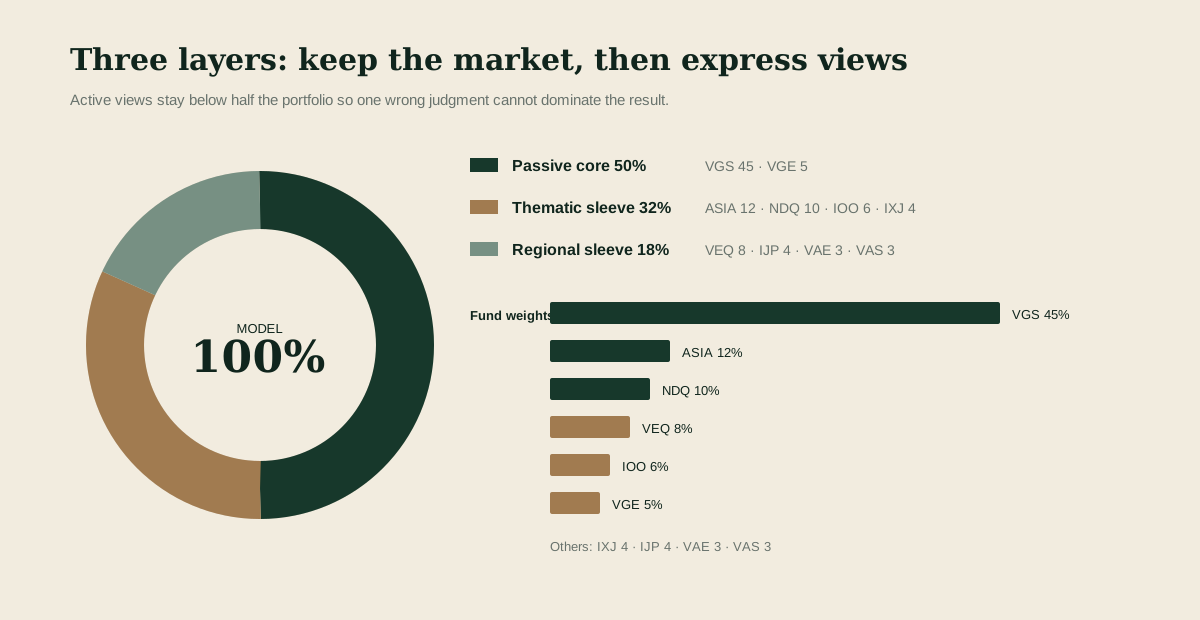
The 50% passive core protects broad market participation if all active judgments are wrong. The 32% thematic sleeve makes long-term views large enough to matter. The 18% regional sleeve reduces dependence on a single US path, while accepting the possibility that these regions underperform for long periods.
Market participation
Retains broad developed and emerging market beta without requiring the next winner to be known today.
Limited active expression
Technology, global champions, and healthcare can affect results, but cannot overwhelm the core.
Lower path dependence
Europe, Japan, Asian real economy exposure, and Australia are not left only to index default weights.
No false precision
The weights are risk boundaries, not a claim that history has produced one exact optimal answer.
03 · What Each Fund Is Asked To Do
A ticker is not an investment reason. Each tool must have a job and be compared with alternatives that could do the same job.
| Code | Illustrative weight | Portfolio role | Rationale |
|---|---|---|---|
| VGS | 45% | Developed market core | Broad exposure to the US, Europe, Japan, and other developed markets |
| ASIA | 12% | Asian technology | Adds Taiwan, Korea, and China technology hardware exposure |
| NDQ | 10% | US new economy | Increases exposure to large technology, platform, and growth companies |
| VEQ | 8% | Europe region | Adds different industries, currencies, and valuation structures |
| IOO | 6% | Global champions | Expresses network effects, global distribution, and high return on capital |
| VGE | 5% | Emerging markets core | Prevents the developed market core from excluding future emerging winners |
| IXJ | 4% | Global healthcare | Adds a long-term demand source different from the technology cycle |
| IJP | 4% | Japan region | Adds manufacturing, automation, and corporate governance change exposure |
| VAE | 3% | Asian real economy | Reduces overconcentration in Asian technology and semiconductors |
| VAS | 3% | Australia domestic | Retains local financials, resources, and potential tax characteristics |
Using public fee schedules and illustrative weights, the model's blended management fee is roughly 0.34% per year. This should be rechecked before implementation and whenever issuers change fees or index methods.
04 · Why The Portfolio Is Built This Way
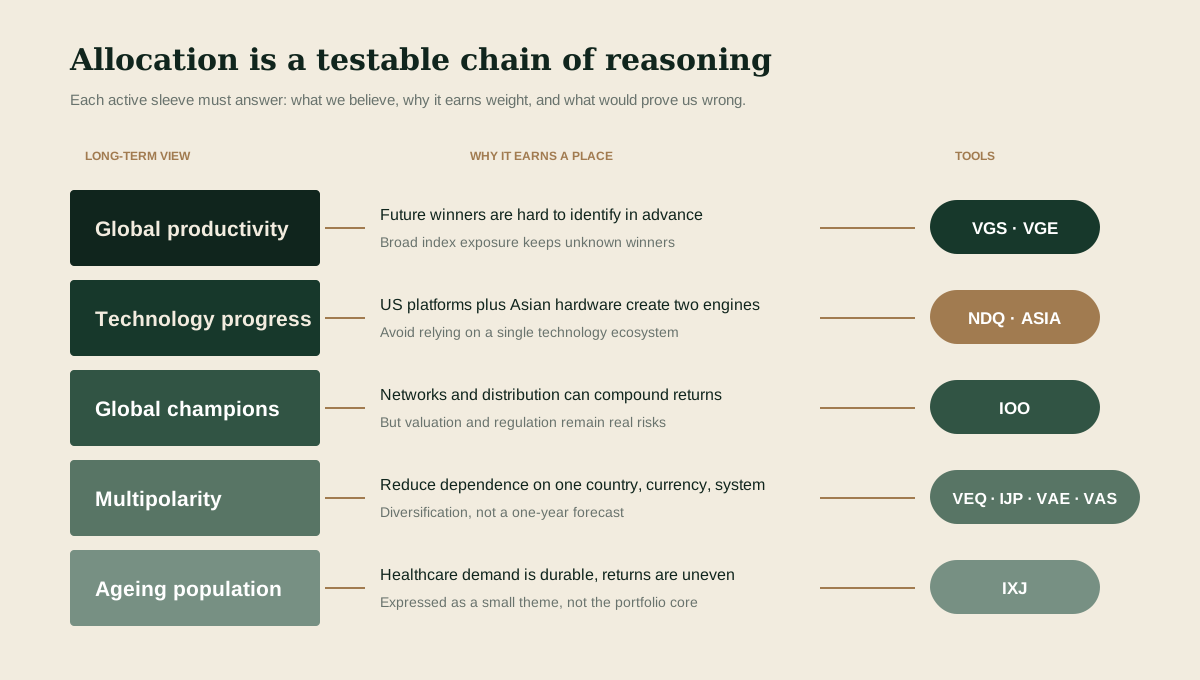
US platforms and Asian hardware as two engines
ASIA at 12% and NDQ at 10% does not mean the portfolio expects Asian technology to replace US technology. VGS, IOO, and IXJ already contain substantial US platform exposure. ASIA's role is to make Taiwan, Korea, and China hardware ecosystems meaningful enough to matter.
The US exposure is more software, cloud, semiconductor design, and global consumer platform. Asian technology exposure is more foundry, memory, manufacturing, and regional platform. Both can benefit from digitisation, but they carry different regulation, currency, and industrial-cycle risks.
Multipolarity is not a short-term forecast
VEQ, IJP, VAE, and VAS provide different currencies, industries, and institutional environments. They buy lower single-path dependence, not guaranteed higher return.
Why healthcare is limited
Population ageing supports healthcare demand, but demand growth does not automatically become shareholder return. Patents, R&D failure, reimbursement, and regulation shape the distribution of profit.
05 · Regional Exposure
Fund names provide only a first-layer label. Real risk has to be looked through to the countries and companies held by each fund.
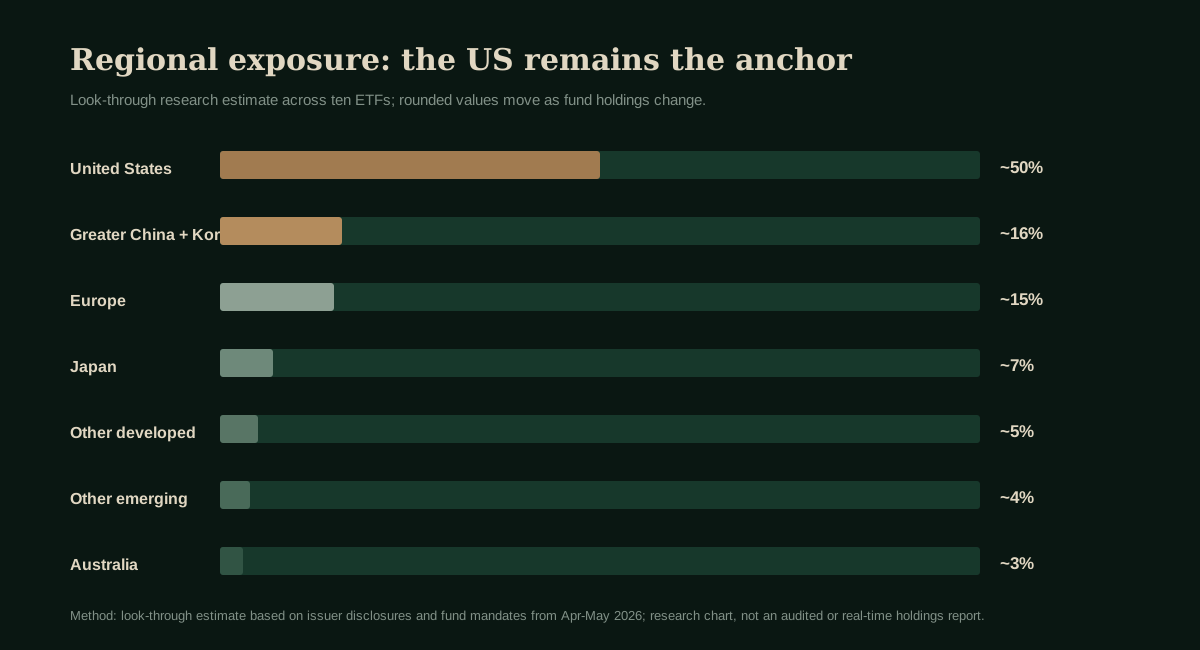
The chart says three things. First, the portfolio still depends heavily on US enterprise innovation and profitability. Second, Greater China and Korea are large enough to matter and require acceptance of geopolitical and policy risk. Third, Europe, Japan, Australia, and other markets reduce single-country dominance, but do not remove equity-market correlation in a crisis.
06 · Sector Tilt And Fund Overlap
More ETFs do not automatically mean more diversification. The same company can appear through the core, technology, and global champion funds.
| Structural tilt | Approximate direction | Cause |
|---|---|---|
| Technology and communication | Meaningfully overweight | VGS already contains large technology, then NDQ, ASIA, and IOO add more |
| Healthcare | Moderately overweight | VGS and IOO include healthcare, then IXJ adds a dedicated sleeve |
| Financials | Relatively underweight | Technology themes consume more active risk budget |
| Traditional industrials | Relatively underweight | Active sleeves are more concentrated in technology and champions |
Hidden single-stock concentration
Large US companies may appear in VGS, NDQ, IOO, and IXJ. Asian semiconductor companies may appear in ASIA, VGE, and VAE. Portfolio review should look through to combined single-company, sector, and country exposure.
- Obtain latest holdings for each fund
- Multiply holdings by portfolio weights
- Combine duplicated companies and sectors
- Check exposure against limits
07 · Every Allocation Trades One Risk For Another
| Active deviation | What it seeks | Risk accepted |
|---|---|---|
| Higher Asian technology | Hardware, manufacturing, and a second technology value chain | Semiconductor cycle and geopolitical risk |
| More Europe, Japan, Australia | Lower US single-path dependence | Long-term underperformance versus the US |
| More global champions | Network effects and high return on capital | Valuation and regulatory concentration |
| More healthcare | A long-term demand source different from technology | Patent, R&D, and reimbursement risk |
Multiple engines contribute
US platforms, Asian hardware, and non-US regions all contribute profit growth.
US leadership continues one-way
Regional diversification drags relative performance for many years.
Technology and geopolitics correlate
US technology valuation compression, Asian semiconductor weakness, and geopolitical shocks occur together.
08 · Rebalancing And Execution Discipline
The purpose of rules is to make changes come from risk and logic, not market mood.
Review index methodology, fees, tax, tracking quality, and theme logic at least once a year.
Set target ranges for each fund. Avoid trading when weights remain within bands.
Use new contributions to add to underweight positions where possible.
Limit combined exposure to single funds, companies, sectors, countries, and themes.
Review immediately if methodology, product availability, fees, or tax treatment changes.
Record the reason, evidence, and expectation behind each major change.
09 · When The Framework Should Change
The portfolio should not change because of every headline, but long-term discipline cannot mean refusing evidence. The failure conditions should be written before they are needed.
- Asian technology provides only cyclical volatility, not durable profitability or global competitiveness.
- Regional funds add cost and overlap without improving risk structure.
- Global champions lose excess returns to regulation, competition, or technology shifts.
- Healthcare demand fails to become sustainable corporate cash flow.
- Fund index design, tax treatment, cost, or tracking quality deteriorates materially.
| Reason for allocation | Should continue to see | Failure signal |
|---|---|---|
| Global passive core | Captures new winners efficiently with stable cost and tracking | Product structure or tax treatment deteriorates |
| Technology dual engine | US platforms and Asian hardware both create global value | Asian exposure is only cyclical, with weak profit quality |
| Global champions | Network effects and high return on capital persist | Competition and regulation steadily damage excess profit |
| Multipolarity | Regions provide different industry and institutional exposure | Only adds cost without improving risk structure |
| Population ageing | Healthcare demand converts into sustainable cash flow | R&D, reimbursement, and regulation consume returns |
Sources, Method, And Disclaimer
Model weights and estimates are as of 30 April 2026. Regional exposure is estimated by multiplying each fund's country weights by the model portfolio weights and rounding for research use. Fees are estimated from public management fees and illustrative weights. Fund holdings, fees, index methodology, and tax documents can change.
- Vanguard VGS product information
- Betashares ASIA product information
- Betashares NDQ product information
- Other product names and investment scopes refer to public materials from Vanguard, Betashares, and iShares.
This page is an illustrative research portfolio. It is not a record of actual holdings, performance, or a recommendation to buy any fund. Any implementation would require consideration of objectives, time horizon, tax, transaction costs, and risk tolerance.