AI opportunities will move from infrastructure into enterprise productivity and physical-world devices, but only companies that pass competition, monetisation, capital intensity, and valuation filters can turn the trend into durable asset returns.
01 · Executive Summary
AI is not a single growth story. It is a stack of technical progress, capital cycle, enterprise workflow redesign, and social response.
Capability does not automatically create revenue
Stronger models are only the beginning. Customers still need to embed the capability into products and workflows.
Revenue does not automatically create cash flow
Compute, data center, and inference costs can make revenue growth diverge from free cash flow.
Productivity gains get redistributed
Value may remain with infrastructure, software platforms, or data owners, or be competed away to customers.
A correct theme can still be overpriced
If the price already assumes rapid adoption, high margins, and low competition, returns can disappoint.
How will AI productivity gains be divided among chip suppliers, cloud platforms, software companies, customers, workers, and consumers?
02 · Three Phases Of AI Value Realisation
The phases can overlap, but they have different capital needs, proof points, and failure modes.
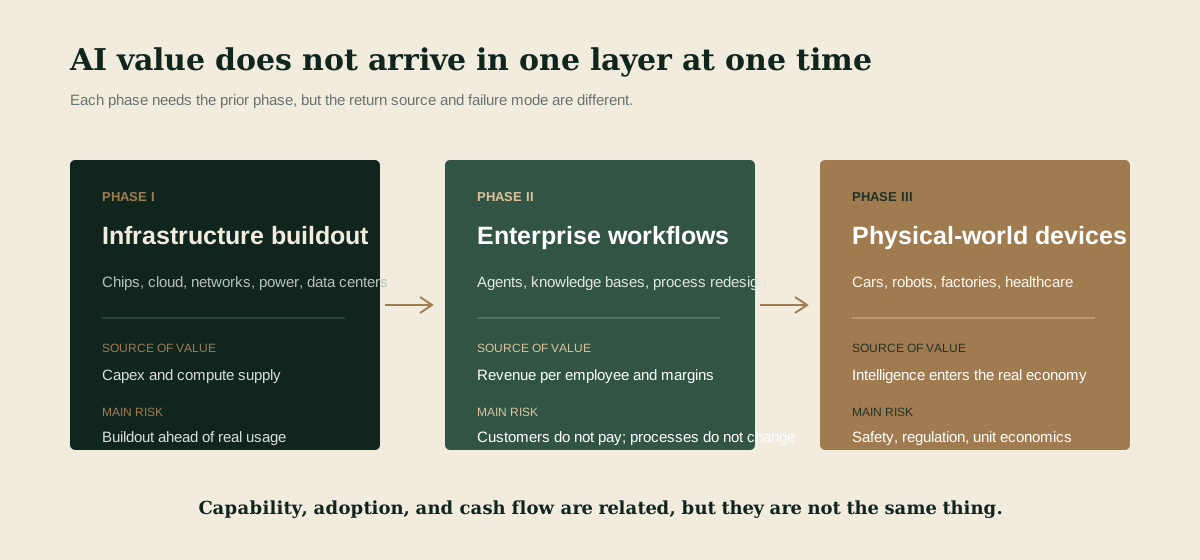
Phase one: compute and infrastructure
GPUs, custom chips, cloud services, high-speed networking, storage, advanced packaging, power, and cooling benefit first. This stage is visible and revenue grows quickly, but it is also vulnerable to overbuilding and demand extrapolation.
Phase two: enterprise workflow redesign
Productivity does not come from occasional chatbot use. It comes when companies redesign processes so systems find tasks, call data, execute steps, record outcomes, and escalate exceptions to humans.
Phase three: physical-world devices
Cars, robots, factories, logistics, and medical devices require perception, reasoning, and action to work reliably together. The market is large, but safety, regulation, hardware cost, and liability slow deployment.
| Phase | Main capital need | Core validation | Typical failure mode |
|---|---|---|---|
| Infrastructure | Chips, data centers, power | Utilisation and customer revenue | Overbuild |
| Enterprise workflow | Software, data, operating change | Ongoing payment and productivity | Stuck in pilots |
| Physical devices | Hardware, manufacturing, compliance | Safety and unit economics | Slow deployment |
03 · Why Capital May Benefit First
Companies can first raise output in specific workflows, then slow hiring, reduce outsourcing, and improve margins. Profit and loss effects can appear before labour markets and policy respond.
- Software raises local process output
- Companies slow hiring and reduce outsourcing
- Cost improvements enter the income statement
- Competition and policy later redistribute benefits
Early impact may look like fewer hires, not immediate layoffs
When companies adopt new tools, they often first slow new roles, delay backfills, and reduce repetitive outsourced work. This is harder to see in macro data than headline layoffs.
Why profit improvement may not be permanent
When peers adopt similar tools, competition can force lower prices or better service, transferring part of the efficiency gain to customers. Long-term winners need pricing power, data, distribution, or workflow control beyond using the same model.
04 · Who May Capture Value
Every layer of the AI value chain can grow, but growth quality and bargaining power differ.
| Position | Possible advantage | How value leaks away |
|---|---|---|
| Compute and infrastructure | Scarcity, technical lead, ecosystem lock-in | Efficiency gains, supply expansion, custom chips |
| Cloud and model platforms | Customer entry point, scale, developer tools | Model commoditisation and price competition |
| Enterprise software | Workflow, data, permissions, distribution | Features absorbed by platforms, weak willingness to pay |
| Data owners | Proprietary data and domain knowledge | Low data quality, compliance limits |
| Physical devices | Software-hardware integration, manufacturing, channels | Safety, liability, deployment cycle, capital intensity |
Enterprise workflow may become the most important and hardest-to-verify layer. The relevant question is not how many AI features are shipped, but whether customers expand contracts, renew, shorten process time, and remove manual steps without sacrificing quality.
05 · From Trend To Investment Return
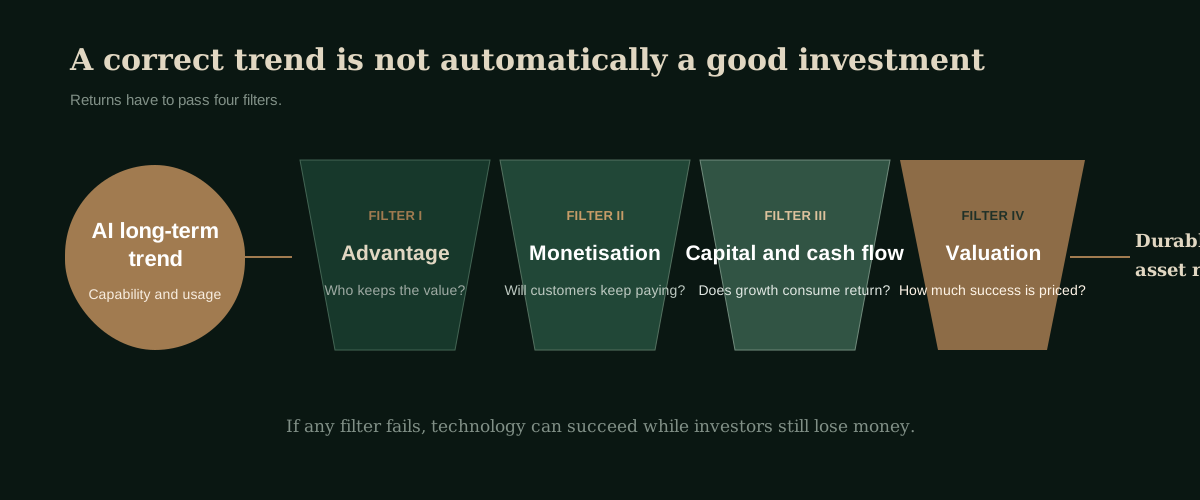
| Filter | Core question | Evidence needed |
|---|---|---|
| Competitive advantage | Who keeps the value created by technology? | Retention, pricing, data, or workflow stickiness |
| Monetisation | Will customers keep paying? | Paid growth and contract expansion, not only usage |
| Capital and cash flow | Is growth consumed by capex and depreciation? | Free cash flow, return on capital, unit economics |
| Valuation | How much success is already embedded? | Implied growth versus real adoption speed |
The filters should be used in order. If a company lacks a clear advantage, fast industry growth may only create low-margin revenue. If monetisation remains unproven, precise terminal valuation is mostly false precision.
06 · Implications For Long-Term Allocation
AI allocation should not mean concentrating only in the most visible companies. It should separate core market participation, limited thematic overweight, and high-uncertainty optionality.
Global diversified core
Keep the market's ability to find future winners, and avoid damaging the portfolio through overconfidence in one beneficiary.
Limited thematic overweight
Add weight only where evidence is durable, monitoring is possible, and the portfolio can tolerate multi-year volatility.
Emerging scenarios
Robotics, autonomous vehicles, and industry agents should be treated as options until deployment and economics mature.
A trend can be right while early beneficiaries are not final winners. Railways, the internet, and mobile communications created enormous value while also producing overinvestment, competition, and valuation resets.
07 · Social And Policy Feedback
AI profit distribution will not be determined by technology alone. Labour markets, regulation, copyright, liability, and public acceptance all affect adoption speed.
Job structure changes
Entry-level work, outsourcing, and standardised knowledge tasks may be affected first.
Copyright and data governance
Data provenance, privacy, and content responsibility may raise compliance cost or strengthen scale players.
Responsibility for errors
Finance, health, automotive, and industrial use cases require clear accountability.
Who receives the gains?
Tax, labour bargaining, and competition determine whether gains go to capital, workers, or consumers.
08 · Validation Dashboard
Cloud AI revenue, backlog, rental pricing, and utilisation should support continued capex.
Agents should move from experiments into core workflows, with customers expanding contracts.
Revenue per employee, profit per employee, process time, and service quality should improve.
AI revenue must cover inference, data center cost, depreciation, and new capex.
Robotics, vehicles, and medical devices must become reliable, safe, and scalable.
Market-implied adoption should be compared with the realistic speed of enterprises, infrastructure, and regulation.
Sources, Method, And Disclaimer
Data and judgments are as of 31 May 2026. This note uses an industry chain and capital-return framework. It does not forecast the capability ceiling of any single model, nor does it equate potential productivity with the future return of any security.
- Microsoft FY2026 Q3 results
- Microsoft Intelligent Cloud performance
- NVIDIA Q1 FY2027 financial results
This note is general research and information only. It is not asset allocation advice, a securities recommendation, an offer, or a solicitation.